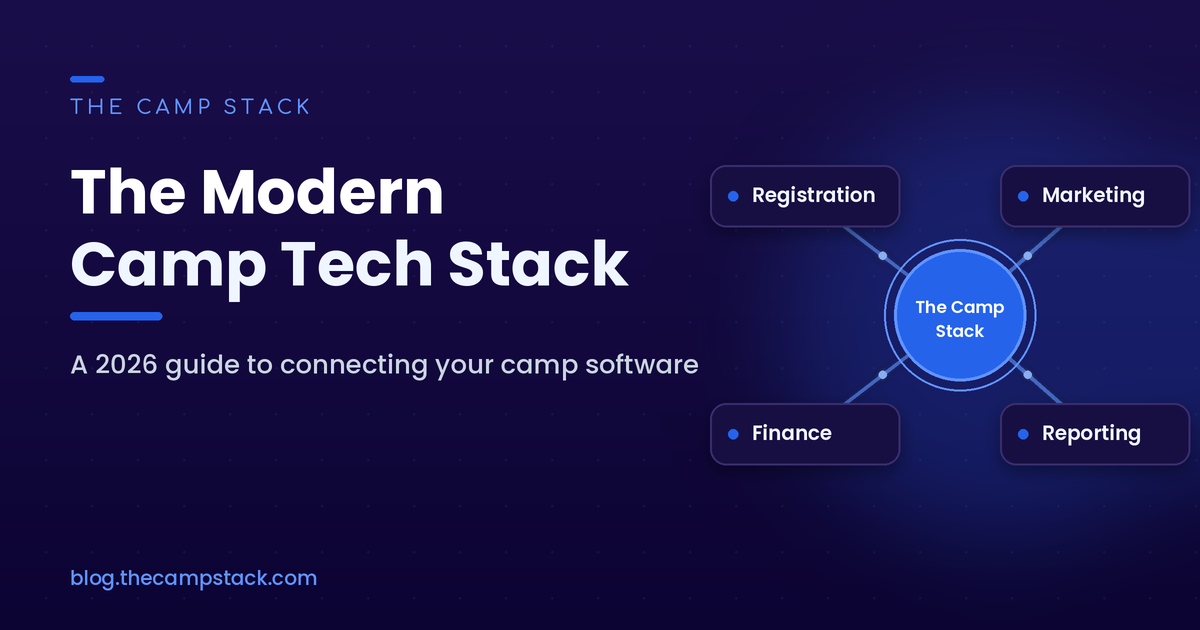
A modern camp tech stack is a connected set of software camps use to handle registration, finance, marketing, and reporting. They are only a stack if they can share data instead of sitting in separate silos. A collection of software that does not share data only creates busywork and is a far cry from a stack that works to help you run camp more effectively.
A great stack is actually less about the tools you buy and more about whether they can connect and talk to each other, as most camps already own great software.
The main problem is that registration, communication, accounting, and reporting tools used by summer camps rarely share data on their own, forcing staff to re-key the same camper information into four places.
In this guide, we will be taking a look at what tools are relevant in a modern camp tech stack and how to connect the pieces so data moves seamlessly and stays current everywhere.
What really is a camp tech stack?
The tech stack is simple: every tool that touches a camper, a family, a dollar, or a decision. For lots of camps, this breaks down into four distinct layers and the connective tissue that ties them together. The tools make up only half of it, with the other half being the flow of data between them. This data flow is exactly where a connected stack earns back staff hours during the busiest weeks of the season.
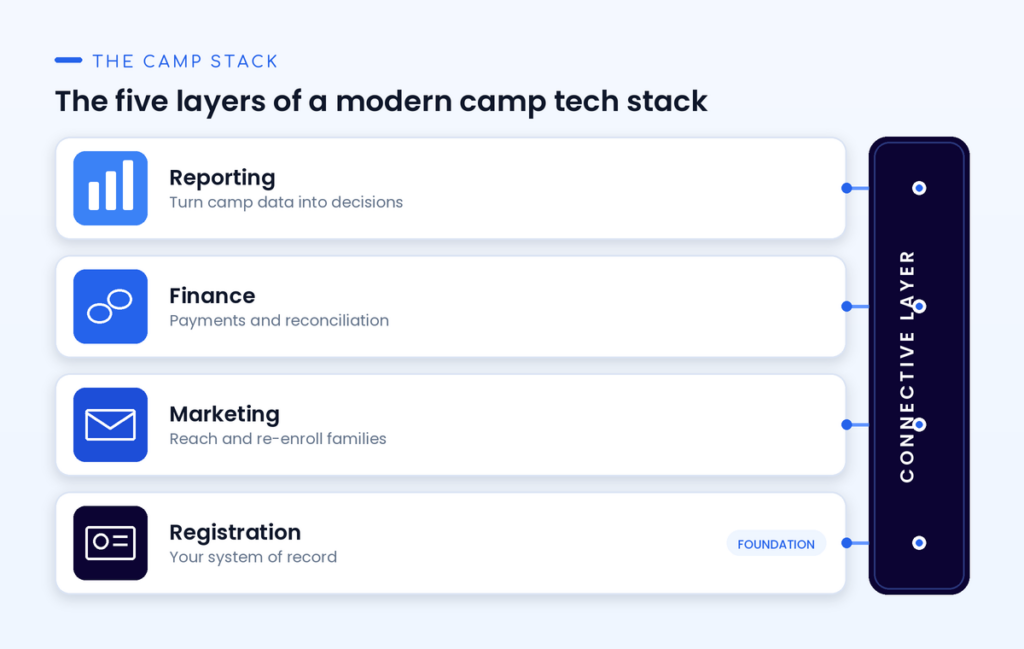
The five layers of a modern camp tech stack
Whether your camp runs only one or twenty sessions, every camp tech stack can be deconstructed into the same working parts. Four layers handle the daily routine work of registration to collect and hold camper data; marketing to keep families informed; finance to handle the money; and reporting to keep camp admins informed and help make decision-making easier.
The fifth layer is the connection that turns it all from a pile of disconnected logins into a camp tech stack that streamlines camp operation by ensuring your tools stop competing for the same data and start sharing it instead. Let us take a look at what belongs in each layer and why they matter.
Registration and camper management
This is the system with which you collect and keep records of campers and families. It is also the primary source of truth to be trusted by every other camp tool for camper and family data. Camp registration software like CampBrain, CampMinder, UltraCamp, and CampSite all belong to this layer.
Clean data here means clean data in every other layer.
Marketing and communication
This layer is responsible for filling up next season while also keeping this season’s parents well informed.
Email and CRM tools like Camper Machine, Mailchimp, Constant Contact, ActiveCampaign, and HubSpot are predominantly used in this layer of camp operations.
Wiring this into your registration and camper management layer ensures that a new registration instantly drops into the right list on its own. This means that a family can sign up just a minute ago and instantly land in your first-timer sequence. No export needed. No copy-paste and zero risk of a three-week-old stale list
Finance
The numbers seen by your bookkeeper have to match the numbers on your registration platform without manual entry. Payments, invoices, and reconciliation are recorded and tracked at this level. If you plan this layer early, it will save you from having to match deposits by hand at the end of the season.
This connection is currently being built at The Camp Stack, and I encourage you to subscribe so you are the first to know when it goes live.
Subscribe to stay updated
Reporting and data
There is no point putting together a camp tech stack you cannot get reports from, as dashboards and a shared data destination like Google Sheets help turn scattered numbers into decisions about enrollment, retention, and staffing.
Reporting is only as good as the data feeding it, and that is why this sits downstream of everything else.
The connective layer
Here is the layer a lot of camps skip, and it is the one that makes the other 4 layers worth owning. The connective layer is responsible for moving data seamlessly between registration platforms, email tools, finance workflows, and reporting in a way that a single camper record updates everywhere at once, which is the entire idea behind All Your Camp Software Connected
Your tools get to stay in sync automatically, saving you the stress of manual exports. You can take a look at our guide to camp software integrations and automations to see how these connections and automations are built, including some use cases that might resonate with your camp.
How to connect your camp tech stack
You do not need to replace your tools to modernize your stack. You need to connect the ones you already have in the right order.
- Name your system of record. Choose the registration platform that holds the truth about campers and families. Everything else reads from it.
- Map where data needs to go. New registrations should reach your email lists. Registration and payment data should reach finance. Everything should reach reporting. Write these flows down before you build anything.
- Use an integration layer, not CSV exports. Manual exports break the moment the season gets busy. A dedicated integration layer keeps data moving without anyone remembering to press a button.
- Handle the tools without an open API. Some camp software does not offer a public API. That does not mean it cannot be connected. There are reliable workarounds for closed platforms, so a missing API is rarely a dead end.
- Verify in-season, not after. Test each connection with a real registration during the first week of the season, while you can still fix a broken flow before it costs you a hundred re-keyed records.
What to fix first
If you only fix one thing this season, connect registration to your email tool so new families land in the right list automatically. It is the flow that touches the most people and eats the most staff time when it is done by hand. From there, connect registration to reporting so you can watch enrollment in real time, then plan the finance connection for your off-season buildout.
Connect your camp tech stack
The Camp Stack links your registration, marketing, finance, and reporting tools so your data moves once and stays current everywhere. Book a consult, and we will map your stack and show you the fastest connections to build first.
Frequently asked questions
What is a camp tech stack?
A camp tech stack is the full set of software a camp runs on, including registration, marketing, finance, and reporting tools, along with the integrations that connect them so data moves between systems instead of being re-entered by hand.
What software should be in a summer camp tech stack?
Most camps need four layers: a registration platform such as CampMinder, CampBrain, UltraCamp, or CampSite; an email or CRM tool such as Mailchimp, Constant Contact, or ActiveCampaign; a finance workflow for payments and reconciliation; and a reporting layer for enrollment and retention data. A connective layer ties them together.
Do camp software tools integrate with each other?
Not on their own in most cases. Registration platforms and marketing tools are usually built by different companies and do not sync automatically, which is why an integration layer is what turns separate tools into a connected stack.
How do I connect camp software that does not have an API?
A missing public API is rarely a dead end. Closed platforms can often be connected through supported workarounds that move registration and family data into your other tools, so you are not limited to only the software that publishes an open API.
What should I fix first in my camp tech stack?
Connect registration to your email tool first. That single flow touches the most families and removes the most manual data entry, which frees staff time during the busiest weeks of the season.